

Beyond Checkbox Compliance: Building Secure, Regulation-Ready Custom Software for Highly Regulated Sectors

If you’re working in a highly regulated sector—whether that’s healthcare, finance, or legal services—you know the feeling. You’ve got this drive to innovate and transform your digital systems, but you’re constantly bumping up against a brick wall of red tape.
A common pattern? Often, it’s just buying off-the-shelf software and hoping it fits. But honestly, most of that stuff is designed for a general audience. You end up with a patchwork of workarounds, or worse, gaping holes in your compliance that keep you up at night.
Over my 15 years in this game, primarily building on the .NET framework, I’ve seen this play out time and again. We stop treating compliance as a box-ticking exercise at the end of a project and start building it into the foundation. When you do that, regulation stops being a chore and actually becomes a strategic edge for your business.
Here is what you need to know about building software that’s truly fit for purpose.
Key Takeaways
- Move beyond simple compliance: Don’t treat regulations as a final hurdle; bake them into the architecture from day one.
- Understand your domain: Whether it’s HIPAA in healthcare or MiFID II in finance, tailor your security to the specific risks your industry faces.
- Design for auditability: If you can’t prove how your system handles data, you don’t have a compliant system. Build in logs and audit trails early.
- Validation is ongoing: You aren’t done once the software is launched; continuous monitoring and change management are what keep you compliant.
- Try a Digital Twin approach: Modelling your regulatory requirements alongside your code can help you predict the impact of changes before they break your system.
Don’t let rigid compliance frameworks stall your digital transformation – contact our team today to discover how custom software can turn regulatory hurdles into your biggest competitive advantage.

The Regulatory Landscape: Knowing the Rules
Before a single line of code is written, you have to know what you’re dealing with. Every sector has its quirks, but they all share a common need: protecting data and proving you’re accountable.
In healthcare, for example, you aren’t just managing data; you’re managing patient safety. You’ve got HIPAA and HITECH demanding strict access controls and audit trails. The HHS summary of the HIPAA Security Rule makes this explicit, requiring administrative, physical and technical safeguards for electronic protected health information. Then there are the FDA regulations if you’re building software as a medical device. It’s a lot to juggle, and the rules continue to evolve
In finance, it’s all about system integrity. Between MiFID II, PCI DSS, and the ongoing AML/KYC requirements, your software needs to be a fortress. For payment environments, the PCI Security Standards Council’s PCI DSS resources focus on the safe handling of cardholder information across the payment data lifecycle. You need to handle transaction reporting and communication archiving without sacrificing the user experience.
And for my friends in the legal world, it’s about absolute confidentiality. Whether it’s solicitor-client privilege or maintaining information barriers between teams, your system needs to be smarter than a standard off-the-shelf package.
A Compliance-First Approach
We’ve moved past the days where you build, test, and then panic about compliance. You need to start with a software requirements specification that really digs into the weeds.
- Talk to the experts: Get your compliance officers involved in the very first planning session. They speak a different language than developers, so build a shared vocabulary early.
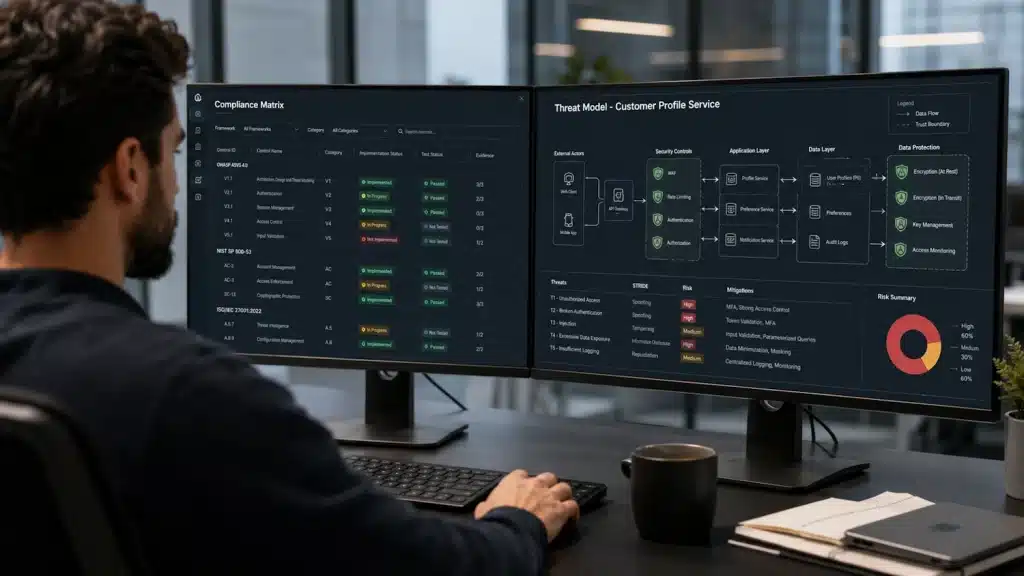
- Map it out: Create a compliance matrix. Every single regulatory requirement should be mapped directly to a piece of your code or design. If you can’t trace it, you can’t prove it.
- Threat modelling: Don’t just build features; build defences. Assume your security controls might fail, and design for that failure. OWASP describes threat modelling as a structured way to identify threats, mitigations and validation steps throughout the software lifecycle.
- Audit by default: Your system should log everything—who accessed what, when, and why.
Essential Features Your Software Needs
If I’m reviewing a spec for a client in a regulated space, I’m looking for a few non-negotiables:
- Granular Access: Forget simple “admin” versus “user” roles. You need attribute-based access control where permissions are tied to specific functions and data sensitivity. NIST defines attribute-based access control as an approach where access decisions are based on attributes of the user, object, requested action and sometimes environmental conditions.
- Tamper-proof logs: If your logs can be edited, they’re useless. We use cryptographic protection to ensure that once a record is written, it’s there for good.
- Data Minimisation: Don’t collect what you don’t need. The less sensitive data you have sitting around, the lower your risk.
- Built-in validation: Your software should be able to run its own self-tests to verify its configuration and integrity.
Ready to eliminate compliance gaps and replace patchy off-the-shelf workarounds? Get in touch with our .NET engineering experts to map out your bespoke, secure software architecture.
The Regulatory Digital Twin
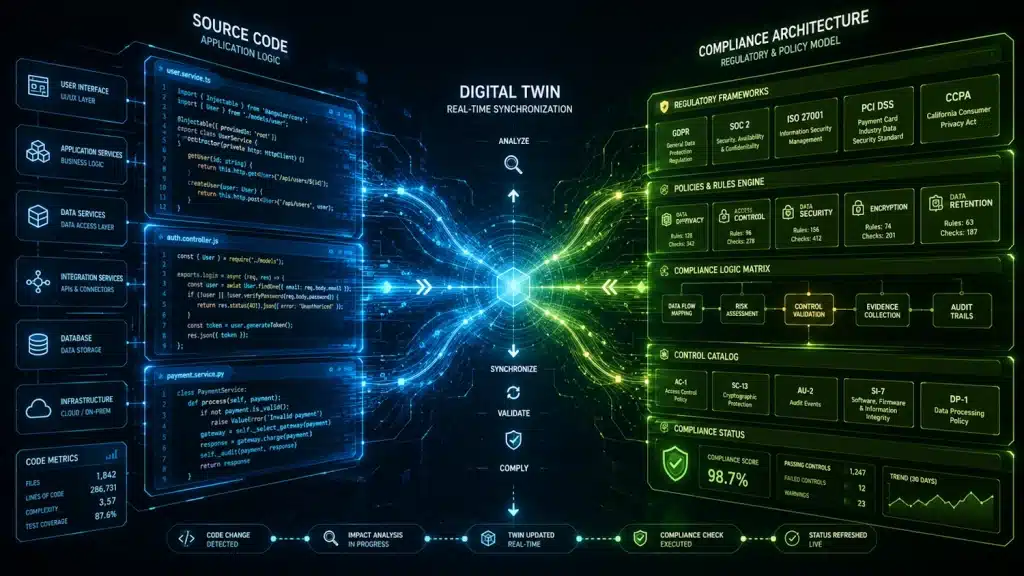
At Full Metal Software, we’ve been playing with an idea we call the “Regulatory Digital Twin.”
What is a Regulatory Digital Twin?
A Regulatory Digital Twin is a parallel digital model of the regulatory environment that interacts with your software development and operations. It serves as both a development tool and an ongoing compliance management system by:
Creating a Dynamic Model of Regulatory Requirements:
- Machine-readable representation of regulations
- Relationships between requirements
- Dependencies and conflicts
- Jurisdictional variations
- Regulatory update tracking
Mapping Software Components to Regulatory Requirements:
- Bidirectional traceability
- Impact analysis capabilities
- Compliance gap visualisation
- Regulatory coverage metrics
- Automated compliance verification
Simulating Compliance Scenarios:
- “What-if” analysis for regulatory changes
- Impact prediction for software changes
- Compliance risk assessment
- Validation scenario generation
- Regulatory change readiness assessment
Providing Real-Time Compliance Dashboards:
- Compliance status visualisation
- Risk area highlighting
- Regulatory change alerts
- Compliance trend analysis
- Stakeholder-specific views
Benefits of the Regulatory Digital Twin Approach
This innovative approach delivers significant advantages over traditional compliance methods:
Proactive Rather Than Reactive Compliance:
- Anticipate regulatory changes before they take effect
- Model the impact of proposed regulations
- Prepare for compliance requirements proactively
- Reduce compliance surprises and emergencies
- Build regulatory intelligence into development processes
Reduced Compliance Overhead:
- Automate routine compliance checks
- Focus manual effort on high-risk areas
- Streamline validation activities
- Reduce documentation burden
- Optimise compliance resource allocation
Improved Regulatory Change Management:
- Assess change impact quickly and accurately
- Prioritise changes based on risk and effort
- Track implementation of regulatory changes
- Verify compliance with new requirements
- Demonstrate regulatory change readiness
Enhanced Stakeholder Communication:
- Provide clear compliance status to executives
- Facilitate communication with regulators
- Improve cross-functional compliance understanding
- Demonstrate compliance posture to customers
- Support audit and inspection preparation
Implementing a Regulatory Digital Twin
While the concept is powerful, implementation requires a thoughtful approach:
Starting Small and Scaling:
- Begin with a single regulatory domain
- Focus on high-risk or frequently changing regulations
- Develop the model iteratively
- Validate the approach with stakeholders
- Expand scope as value is demonstrated
Technology Considerations:
- Knowledge graph technologies for relationship modeling
- Natural language processing for regulatory text analysis
- Integration with development and compliance tools
- Visualisation capabilities for complex relationships
- API-driven architecture for extensibility
Organisational Considerations:
- Cross-functional team involvement
- Compliance and legal expertise integration
- Executive sponsorship
- Clear ownership and governance
- Training and change management
The Regulatory Digital Twin represents one possible future for compliance management for regulated software—transforming compliance from a burden into a strategic capability that supports innovation while managing risk.
Think of it as a living, breathing model of the regulations that apply to you.
Instead of keeping your requirements in a static document that gets dusty, you build a digital model that interacts with your development process. If a regulation changes, you update the model, and it tells you exactly which parts of your software are now at risk. It’s proactive, it’s efficient, and it saves you from those nasty surprises when an auditor shows up.

Conclusion
Developing custom software for regulated industries requires a specialised approach that places compliance and security at the core of the development process. By implementing a compliance-first development methodology, organisations can create software that not only meets regulatory requirements but turns them into a competitive advantage.
The key to success lies in understanding the specific regulatory landscape, implementing a structured development approach, incorporating essential compliance features, applying rigorous testing and validation, and maintaining compliance throughout operations. Innovative approaches like the Regulatory Digital Twin can further enhance compliance capabilities while reducing overhead.
For organisations in regulated industries, custom software development represents a strategic investment that can simultaneously address compliance needs, improve operational efficiency, and drive innovation. By working with development partners who understand both the technical and regulatory dimensions of your industry, you can create solutions that transform compliance from a burden into a business enabler.
Transform compliance from an operational burden into a powerful, strategic enabler – contact Full Metal Software today to discuss building your custom, regulation-ready solution.
Frequently Asked Questions
1. Is custom software always better than off-the-shelf solutions for compliance?
Not always, but in highly regulated sectors, off-the-shelf software often leaves you with massive “compliance gaps.” Custom development allows you to bake your specific regulatory needs into the core of the system, reducing the need for risky, manual workarounds.
2. How do I get my developers to care about compliance?
Compliance shouldn’t be a separate task for someone else. When developers understand that secure, compliant code is actually higher-quality code, they buy in. Involving them in the risk-assessment process early makes it a shared goal rather than an external chore.
3. What is the biggest mistake you see companies make with software audits?
Failing to maintain the “validated state.” Many teams build compliant software, but then fail to update their documentation or trace their changes when they push updates later. If you can’t show the audit trail for every change, you’re in trouble.
4. How does the .NET ecosystem help with these requirements?
For my work in .NET, the strong typing and mature security libraries are a huge help. It’s much easier to enforce coding standards and audit trails when the framework provides such a solid, predictable structure for building secure services.
5. How do I start with a Regulatory Digital Twin?
Don’t try to model everything at once. Start with your highest-risk domain—perhaps patient data or transaction reporting. Once you see the value in how it highlights compliance gaps, you can gradually expand the scope to cover other areas of your business.
Further Reading
We cover all sorts of topics in our Bespoke Software category of posts.


