

The Heart of Your Software: A Practical Guide to Functional Requirements for UK SMEs

From Blueprint to Building Regs
If you’re thinking about getting bespoke software built, you’ve probably heard people compare the initial plan to an architect’s blueprint. It’s a decent starting point. It shows you the big picture – where the rooms are, the general layout, and how it all fits together.
But let’s be honest, you can’t build a house with just a blueprint. You need the nitty-gritty details. You need the schematics that tell the electrician exactly what a socket needs to do, the plumber how the water needs to flow, and the heating engineer which safety standards the boiler has to meet.
Those details, the “building regulations” of the software world, are what we call functional requirements. They’re the specific, testable instructions that turn a nice idea into a piece of software that actually works. Without them, you’ve just got a pretty picture; with them, you have a genuine business asset.
For any SME in the UK, a custom software project is a big deal and a serious investment. I can tell you from 15 years of experience in this game, the biggest risk isn’t dodgy code; it’s a simple, and costly, misunderstanding between what your business needs and what the development team builds. An eye-watering number of projects go over budget, miss deadlines, or get cancelled altogether, simply because everyone wasn’t on the same page from the start.
This guide is designed to get you on that page. It’s not some dry, academic paper. It’s a practical look at what a good functional requirement actually looks like, how your “wants” get turned into concrete instructions for developers, and how you can spot the common mistakes that lead to expensive re-dos.
Think of getting your functional requirements right as a form of project insurance. It forces a level of clarity that is the single best way to reduce risk, get an accurate quote, and, ultimately, get the software you actually asked for. This process of documenting requirements is a vital part of creating a formal Software Requirements Specification (SRS), a standard endorsed by industry bodies like the Institute of Electrical and Electronics Engineers (IEEE).
Worried about your software project going off the rails? Let’s talk. We specialise in turning business needs into rock-solid project plans that deliver on time and on budget.

The Anatomy of a Bulletproof Functional Requirement
So, what does a good requirement look like? It’s not just a quick sentence about a feature. A properly put-together functional requirement is a clear, self-contained instruction that leaves absolutely no room for a developer to guess what you mean.
Let’s use a real-world example we see all the time: a feature in a bespoke Customer Relationship Management (CRM) system for logging customer chats. Here at Full Metal, we break every requirement down into five core parts to make sure we get it right.
1. Unique Identifier (ID)
Every single requirement gets a unique code, something like FR-CRM-021. This isn’t just us being bureaucratic, I promise.It’s the bedrock of keeping everything traceable. It means the project manager, the developer, and the tester are all talking about the exact same thing. When a bug pops up or a change is needed, we can trace it back to this specific ID, which saves a world of confusion.
2. Action-Oriented Description
The description has to be precise. We use non-negotiable language like the system “shall” or “must” do something. Vague words lead to vague results.
- Poor Example: “The system should handle new notes.”
- Good Example: “The system shall allow an authenticated user to add a time-stamped note to a customer record.”
See the difference? One is a suggestion; the other is a command. It makes what the system needs to do explicit.
3. Inputs, Processing, and Outputs
This is where we spell out the logic from start to finish.
- Inputs: What kicks the whole thing off? For our CRM note, the inputs are the user clicking the ‘Save Note’ button and having typed something into the text box.
- Processing: What does the system do in the background? It checks that the note isn’t empty, links it to the current user and the customer record they’re looking at, and adds a server timestamp.
- Outputs: What does the user see? The new note appears at the top of the customer’s activity feed, and a little “Note Saved” message pops up for a second.
4. Rationale
This is the “why.” Why are we even building this? Linking the technical instruction back to a business goal gives the development team context and makes sure every feature has a proper purpose.
- Rationale for FR-CRM-021: “To ensure all team members have a complete and up-to-date history of customer interactions, reducing duplicate effort and improving the quality of customer service.”
5. Acceptance Criteria
This might just be the most important part. Acceptance criteria are a simple list of pass/fail conditions that prove the feature is working as intended.They form the script for our testers.
- Criterion 1: Given an authenticated user is on a customer record page, when the user types text into the note field and clicks ‘Save’, then the note must appear in the activity feed.
- Criterion 2: Given an authenticated user is on a customer record page, when the user clicks ‘Save’ with an empty note field, then an error message stating “Note cannot be empty” must be displayed, and no note is created.
- Criterion 3: Given a note has been successfully saved, then it must display the correct user’s full name and the server-generated date and time of creation.
This structure turns a vague wish list into a proper, logical process. It builds quality in from day one, making sure everything is verifiable and measurable.
The 7 Flavours of Functional Requirements
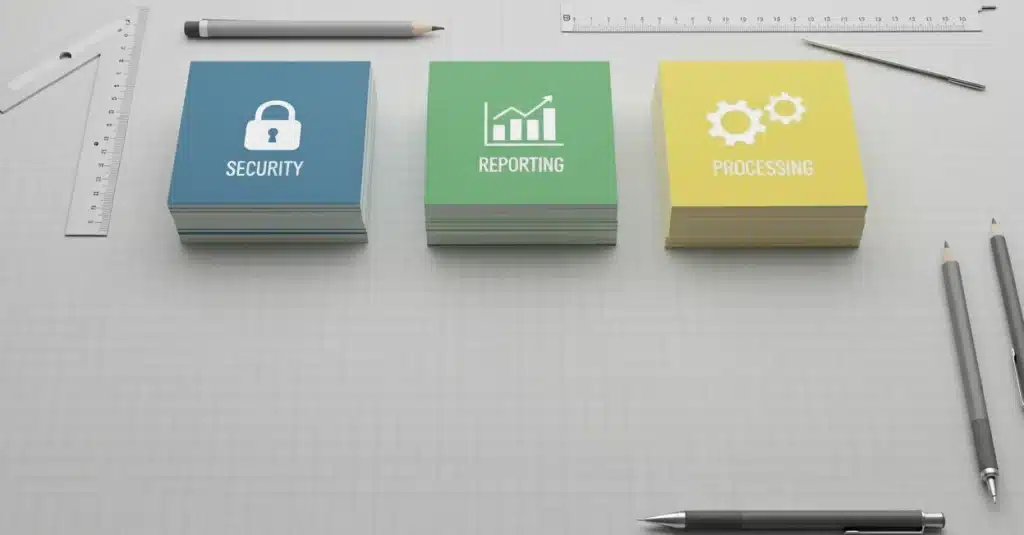
When you’re first thinking about a new system, the list of potential features can feel a bit overwhelming. A great way to get your head around it is to group requirements into different ‘types’ or ‘flavours’. It acts as a mental checklist, making sure you don’t accidentally forget a whole area of functionality.
- Business Rules: These are the rules that make your business unique. They often involve calculations or specific policies. For example: “For UK-based customers, the system shall apply a 20% VAT rate to all products except those in the ‘Zero-Rated’ category.”
- Authentication & Authorisation (Permissions): This is all about who can get into the system and what they can do when they’re in there. Authentication is logging in; authorisation is what you’re allowed to see. For example: “The system shall only allow users with the ‘Finance Manager’ role to access the ‘Company Payroll’ report.”
- Data Processing & Management: This is the bread and butter of most business software—the ability to Create, Read, Update, and Delete data (often called CRUD). For example: “Upon creating a new client, the system shall automatically generate a unique 7-digit Client ID that cannot be changed.”
- Reporting & Notifications: How does the system tell you things? This covers everything from on-screen reports to automated email alerts. For example: “The system shall generate a monthly sales PDF report and email it to all ‘Sales Directors’ on the first working day of the month.”
- System Integrations: Your software doesn’t live in a bubble. These requirements define how it will talk to other platforms you use, like Xero or HubSpot. For example: “When an invoice is marked as ‘Paid’, the system must make an API call to Xero to create a corresponding payment record.”
- Audit & Logging: This is often forgotten but is so important for security and figuring out what went wrong when something breaks. It’s about keeping a record of important actions. For example: “The system shall log an unchangeable audit trail entry whenever a customer’s credit limit is changed.”
- Backup & Recovery: What happens if it all goes wrong? These requirements define how your data is protected. For example: “The system shall perform an automated, encrypted daily backup of the customer database to a secure, off-site location.”
Thinking in these categories helps you see the bigger picture. Forgetting about ‘Authentication’ isn’t just missing a feature; it’s leaving the door wide open for fraud. Skipping ‘Backup & Recovery’ isn’t a small oversight; it’s gambling with your entire business continuity plan.
Feeling overwhelmed by the details? Our team can help you explore every angle of your project, ensuring no critical requirements are missed. Schedule a free consultation today.
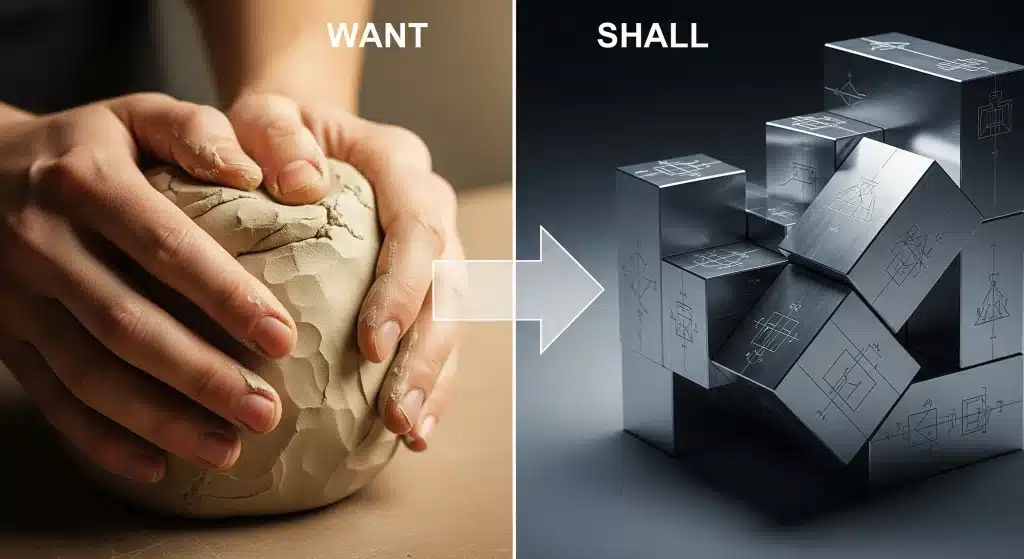
User Stories vs. Functional Requirements: From ‘Want’ to ‘Shall’
People often get confused between “user stories” and “functional requirements,” but they aren’t the same thing. Think of them as two essential steps in the same process: turning a human need into a technical instruction.
A User Story is your perspective. It’s written in plain English and usually follows this format: “As a [type of user], I want [to do something], so that I can [achieve a goal]”. It captures the ‘who’, ‘what’, and ‘why’ from your point of view. It’s the “want”.
A Functional Requirement is the system’s perspective. It’s the precise, testable instruction detailing how the system will make the user story happen. It’s the “shall”.
The real work, and where a good development partner earns their keep, is in translating that conversational “want” into a set of rock-solid, testable “shalls”. You’d be amazed how a single, simple-sounding user story can blossom into five, ten, or even more highly specific functional requirements.
Here’s a quick example of that translation in action:
| Feature | User Story (The ‘Want’) | Functional Requirements (The ‘Shalls’) |
| Password Reset | “As a forgetful user, I want to reset my password, so that I can get back into my account.” | FR-AUTH-010: The system shall provide a ‘Forgotten Password?’ link on the login page. FR-AUTH-011: When a user enters their registered email, the system shall send a unique, single-use, time-limited (2 hours) password reset link to that address. FR-AUTH-012: The new password form shall require the password to be entered twice for confirmation. FR-AUTH-013: The new password must be validated against the system’s complexity rules (as defined in FR-SEC-005). |
This journey from a simple request to a detailed spec is why meticulous planning is so important.
The Secret Sauce: Trying to Break Your Requirements Before We Build Them
Getting a clear requirement written down is step one. But what separates an adequate project from a great one is actively trying to break the logic of that requirement before a single line of code gets written. It’s a bit like being a crash-test dummy for the project plan.
We do this by thinking through different scenarios, especially the “what ifs”.
The “Happy Path”: This is the ideal situation where the user does everything perfectly, and the system works just as expected. For our password reset, the user enters the right email, gets the link, and sets a new password. Simple.
The “Unhappy Paths”: This is where the real work happens. We sit down and ask a series of “What if…?” questions to find any gaps or potential problems.
- What if the user enters an email that isn’t registered? (We need a requirement for a generic message to stop hackers from guessing valid emails).
- What if the user clicks the reset link after it’s expired? (We need a requirement for an “Expired Link” page that helps them start again).
- What if the user tries to set their new password to be the same as their old one? (We need a requirement to reject it with an error message).
This is basically pre-emptive debugging. We find and fix logical flaws on paper, where it costs next to nothing, rather than in the code, where it can cost a fortune.

Common Pitfalls: Lessons Learned From the Trenches
After years of doing this, you start to see the same mistakes crop up time and again. Avoiding these is key to a smooth project.
The Ambiguity Trap
- Mistake: Using fuzzy words like “fast,” “easy,” or “user-friendly.”
- Why it’s a Problem: My “fast” might be very different to your “fast”. You can’t test “fast”.
- The Fix: Quantify everything. Don’t say “The system should be quick.” Say “The system
shall return a response within 500ms for 99% of users.” One is a wish, the other is a contract.
The “Frankenstein” Requirement
- Mistake: Lumping several different actions into one requirement. For instance: “The system shall validate the user, show a welcome message, and send a verification email.”
- Why it’s a Problem: What if the login works but the email fails? Is the requirement met? It’s confusing to build and impossible to test properly.
- The Fix: Break it down. Each individual action gets its own requirement and its own ID. Simple, clean, and testable.
Designing in Disguise
- Mistake: Telling the developers how to build it, not what you need it to do. For example: “The system shall use a PostgreSQL database to store customer records.”
- Why it’s a Problem: This is a design choice, not a business need. You’re paying experts to choose the best tools for the job; tying their hands can lead to a weaker final product.
- The Fix: Focus on the outcome. The requirement should be: “The system shall securely store customer records.” Let the tech team figure out the best way to do that.
Forgetting the Gatekeeper
- Mistake: Treating security and permissions as an afterthought to be bolted on later.
- Why it’s a Problem: I’ve seen it happen, and trying to add security to a system that wasn’t designed for it is a nightmare. It’s expensive, ineffective, and leaves you vulnerable.
- The Fix: Build security in from the start. For every single requirement, ask the question: “Who should be allowed to do this?”
The Bedrock of Your Bespoke Software
The path from a business idea to a working piece of software can feel long and complicated, but a successful project is always built on one thing: a solid foundation of clear, testable functional requirements. They truly are the bedrock of the whole enterprise.
By taking a structured approach – insisting on IDs, spelling out the ‘why’, and defining clear acceptance criteria – you systematically kill the ambiguity that causes so many projects to fail. It builds a powerful bridge between you and the development team. Stress-testing those requirements with “what if” scenarios before you start is one of the smartest, money-saving moves you can make.
Ultimately, getting this right delivers real business value. It leads to more accurate quotes, a smoother development process, and far fewer nasty surprises. It ensures the final product you receive is a high-quality asset that gives you a genuine return on your investment. If you’re ready to turn your idea into a concrete plan, working with a partner to translate your needs into a robust specification is the most important first step you can take.
Ready to build a genuine business asset? Contact us today, and let’s create a detailed software specification that guarantees the success of your project.
Further Reading
Read more about SRSs in our Software Requirements Specification category of our blog.


